OVERTHINKING & ANXIETY IN RELATIONSHIPS
Overthinking & Anxiety
OVERTHINKING & ANXIETY IN RELATIONSHIPS
7 min read
Overthinking can make relationships feel more complicated than they really are. A delayed text, a change in tone, or a quiet evening can quickly turn into a series of questions and worst-case scenarios. Understanding the connection between overthinking and relationship anxiety can help you respond to uncertainty with more clarity.
WHY DO WE OVERTHINK IN RELATIONSHIPS?
Relationships involve uncertainty.
You can't always know what your partner is thinking, how they feel, or what will happen next. For some people, that uncertainty can quickly turn into overthinking.
You might replay a conversation from earlier in the day.
You might wonder why your partner's message sounded different.
You might analyze something they said and look for a hidden meaning.
The more you think about it, the more questions appear.
Overthinking often feels like you're trying to solve a problem. But instead of giving you an answer, it can create even more uncertainty.
WHAT IS RELATIONSHIP ANXIETY?
Relationship anxiety refers to feelings of worry, insecurity, or fear connected to your relationship.
It can show up in different ways.
You might constantly wonder whether your partner still loves you.
You might worry that they're going to leave.
You might question whether you're compatible.
You might compare your relationship to other couples.
Or you might repeatedly question whether you're making the right decision.
Some uncertainty is normal in relationships.
The problem is when the uncertainty becomes so frequent that it starts affecting how you experience the relationship.
WHEN A THOUGHT BECOMES A STORY
One of the biggest problems with overthinking is that a small piece of information can quickly become an entire story.
For example:
Fact: Your partner hasn't replied for several hours.
Thought: Maybe they're busy.
Story: They're losing interest, they're talking to someone else, and our relationship is probably ending.
The story may feel completely real.
But it is still an interpretation.
Learning to separate what you know from what you're imagining can be one of the most useful ways to manage relationship anxiety.
WHY YOUR BRAIN LOOKS FOR THE WORST-CASE SCENARIO
When something feels uncertain, your brain naturally tries to predict what could happen.
This can sometimes be useful.
But anxiety can make your mind focus heavily on negative possibilities.
Instead of thinking about several possible explanations, you may immediately focus on the one that scares you most.
A short message becomes rejection.
A disagreement becomes a sign of incompatibility.
A need for space becomes abandonment.
The emotion is real.
But the conclusion may not be.
Recognizing this difference can help you slow down before reacting.
REASSURANCE CAN BECOME A CYCLE
When you're anxious about your relationship, reassurance can feel like the fastest way to feel better.
You ask:
"Are we okay?"
Your partner says yes.
For a while, you feel calm.
Then another doubt appears.
You ask again.
The problem is that reassurance can sometimes provide temporary relief without addressing the underlying uncertainty.
You may start depending on external reassurance to feel safe.
Learning to tolerate some uncertainty can help break this cycle.
DON'T ANALYZE EVERY DETAIL
When you're anxious, you may start looking for clues everywhere.
How long did they take to reply?
Why did they use that emoji?
Why didn't they ask about my day?
Why did they seem quiet?
Why were they online but didn't respond?
You can spend hours analyzing details that may have completely ordinary explanations.
Instead of asking what every individual action means, step back.
Look at the relationship as a whole.
How does this person generally treat you?
Do they communicate with you?
Do they make time for you?
Do they show care through their actions?
A single moment rarely tells you as much as a consistent pattern.
LEARN TO SIT WITH UNCERTAINTY
You don't have to answer every question immediately.
Sometimes the healthiest response to uncertainty is simply:
"I don't know yet."
You don't know why they haven't replied.
You don't know exactly what they're thinking.
You don't know what will happen next month.
And that's okay.
Not knowing doesn't automatically mean something is wrong.
Giving yourself permission not to have an immediate answer can reduce the pressure to constantly analyze and predict.
CHECK THE FACTS BEFORE YOU REACT
When you notice yourself overthinking, pause before doing anything.
Ask yourself:
What do I actually know?
What am I assuming?
What evidence supports my interpretation?
Is there another possible explanation?
Is this a new situation or a repeated pattern?
These questions can create distance between the initial emotion and your reaction.
You don't have to convince yourself that everything is fine.
You simply want to make sure you're responding to information rather than fear.
TALK INSTEAD OF GUESSING
Sometimes the best way to reduce relationship anxiety is to communicate directly.
If something has genuinely changed, ask about it.
Instead of spending hours wondering why your partner has been distant, you can say:
"I've noticed we've felt a little disconnected lately. Is everything okay?"
A conversation gives you actual information.
Guessing doesn't.
Good communication doesn't guarantee that you'll always get the answer you want.
But it gives you a much better chance of understanding what is actually happening.
DON'T LET ANXIETY MAKE YOUR DECISIONS
When anxiety is high, you may feel an urgent need to do something.
Send another message.
Ask for reassurance.
Start an argument.
Check social media.
Pull away before they can reject you.
End the relationship before you can get hurt.
These actions can create temporary relief.
But relief isn't always the same thing as resolution.
Before reacting, ask yourself:
"Am I doing this because it reflects what I actually want, or because I want the uncomfortable feeling to stop?"
That question can change the decision you make next.
LOOK FOR PATTERNS, NOT PERFECTION
No relationship feels perfectly secure all the time.
People have bad days.
They get busy.
They misunderstand each other.
They need space.
They sometimes communicate poorly.
A healthy relationship isn't one where you never feel anxious.
It's one where you can look at the overall pattern and still feel respected, valued, and able to communicate.
Don't expect every moment to feel perfect.
Look at what happens consistently.
UNDERSTANDING YOUR ANXIETY
Relationship anxiety doesn't mean that you're incapable of having a healthy relationship.
It may simply mean that certain situations trigger strong emotional reactions for you.
The more you understand those reactions, the easier it becomes to recognize them before they control your behavior.
You can learn to notice when you're making assumptions.
You can learn to communicate instead of guessing.
You can learn to tolerate uncertainty without immediately seeking reassurance.
And you can learn to distinguish between anxiety and genuine relationship concerns.
FINDING MORE CLARITY
The goal isn't to never overthink again.
Everyone has moments of doubt.
The goal is to understand what is happening when those thoughts appear.
Is there a real problem that needs to be addressed?
Is an old fear being triggered?
Are you reacting to a pattern or a single moment?
Are you looking for information, or simply trying to make anxiety disappear?
The better you understand your own patterns, the easier it becomes to respond to your relationships with intention instead of automatically reacting to fear.
You don't need to have every answer immediately. Sometimes clarity starts with understanding which thoughts are facts, which are fears, and which deserve your attention.
EXPLORE MORE ABOUT RELATIONSHIPS
Get a deeper understanding of yourself and your relationships with Amorza. Explore your thoughts, emotions, patterns, and connections — and find more clarity in the way you love and communicate.

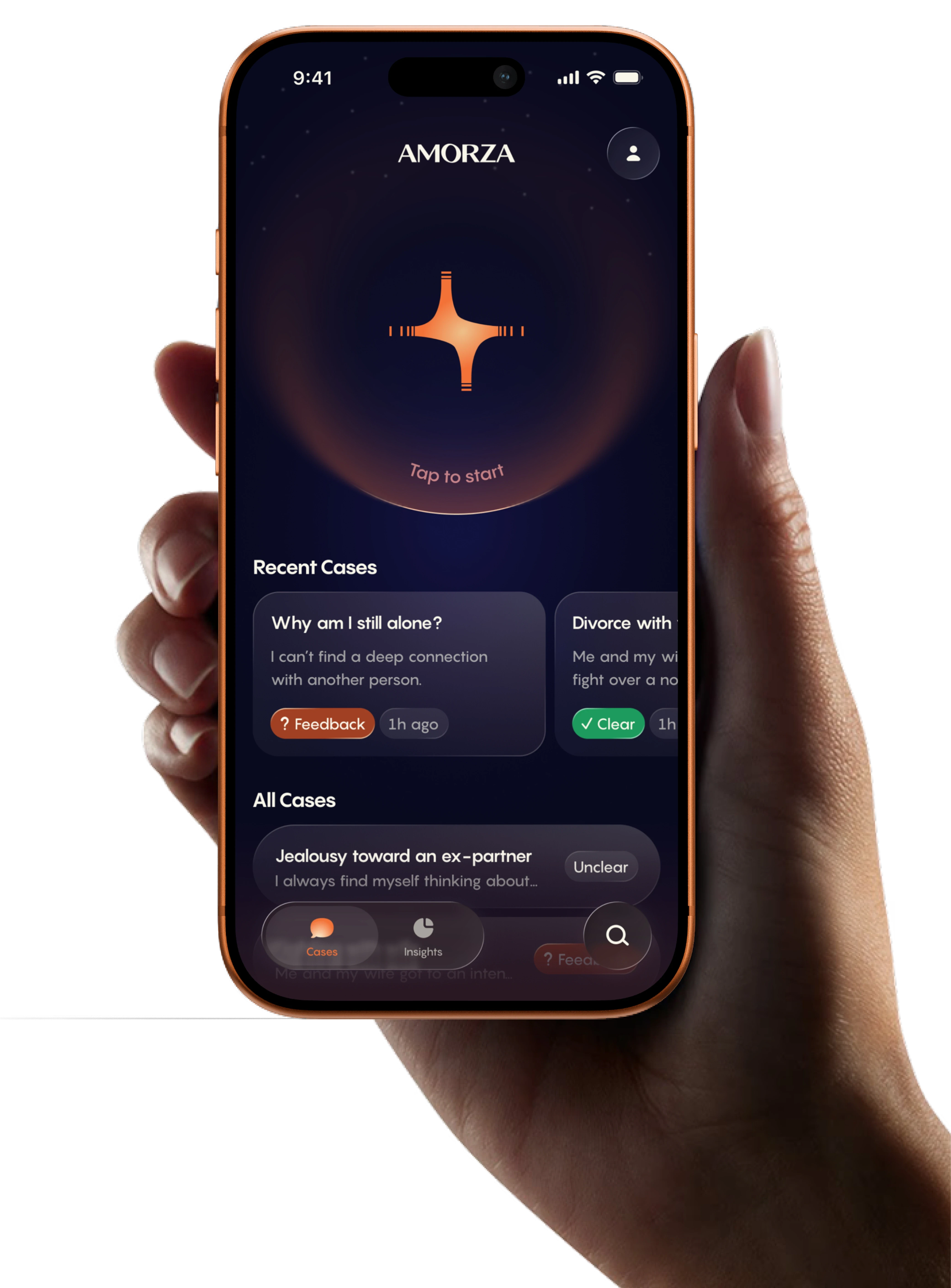
Amorza is an AI tool for relationship clarity.
It is not a substitute for professional psychological or therapeutic support.