READING SIGNALS & RED FLAGS
Reading Signals & Red Flags
WHAT ARE RELATIONSHIP SIGNALS?
Relationship signals are the small behaviors, words, and actions that can give you information about how someone feels or how they approach a relationship.
They can be obvious.
Someone consistently makes time for you, communicates openly, and follows through on what they say.
Other signals can be much more subtle.
Maybe they become more distant after getting close.
Maybe they avoid conversations about the future.
Maybe they are affectionate one day and completely unavailable the next.
The challenge is knowing which signals actually matter.
LOOK AT THE PATTERN, NOT ONE MOMENT
One of the easiest mistakes to make when reading someone's behavior is focusing on a single interaction.
A late reply doesn't automatically mean someone is losing interest.
A cancelled plan doesn't necessarily mean they don't care.
A quiet day doesn't automatically mean something is wrong.
People have busy days, different moods, and different communication styles.
What matters more is what happens repeatedly.
Ask yourself:
Is this a one-time event or a pattern?
Patterns usually tell you much more than individual moments.
POSITIVE SIGNALS TO PAY ATTENTION TO
Healthy relationships aren't about finding someone who behaves perfectly.
They're about finding consistency, respect, and mutual effort.
Some positive signals include:
They communicate openly
Their words generally match their actions
They respect your boundaries
They make an effort to spend time with you
They are willing to discuss difficult topics
They take responsibility when they make mistakes
They show interest in your life
You feel comfortable being yourself around them
You can disagree without feeling threatened
None of these guarantees that a relationship will work.
But together, they can create a strong foundation.
WHAT ARE RED FLAGS?
A red flag is a behavior or pattern that may indicate a deeper problem in a relationship.
Not every uncomfortable behavior is automatically a red flag.
The context matters.
For example, someone needing time alone isn't necessarily a problem.
But repeatedly using silence to punish you can be very different.
A red flag becomes more significant when a behavior is repeated, causes harm, or shows a lack of respect for your boundaries.
COMMON RED FLAGS IN DATING
Some relationship red flags are easier to recognize than others.
Pay attention if someone consistently:
Disrespects your boundaries
Lies or hides important information
Blames everyone else for their problems
Refuses to take responsibility for their actions
Tries to control who you spend time with
Makes you feel guilty for having normal needs
Dismisses your feelings
Frequently insults or humiliates you
Uses jealousy as a way to control you
Threatens to leave whenever there is conflict
One difficult moment doesn't necessarily define someone.
Repeated behavior does.
MIXED SIGNALS CAN BE INFORMATION TOO
Sometimes the biggest source of confusion isn't a clear red flag.
It's inconsistency.
Someone may tell you they want a relationship but avoid emotional closeness.
They may make plans and repeatedly cancel them.
They may disappear and then return with intense attention.
They may talk about how much they care while rarely showing it through their actions.
This doesn't automatically tell you why they're behaving this way.
But it does give you information about the relationship you're experiencing.
You don't always need to know the reason behind someone's behavior to recognize its impact on you.
DON'T CONFUSE CHEMISTRY WITH COMPATIBILITY
Strong chemistry can make it difficult to notice problems.
You may feel an intense connection with someone and assume that intensity means the relationship is right.
But chemistry and compatibility are different.
Chemistry is about attraction and emotional excitement.
Compatibility involves things like values, communication, expectations, lifestyle, and how you handle conflict.
Someone can make you feel incredible and still not be a good long-term match.
That's why it's important to look beyond how strongly you feel.
Look at how the relationship actually works.
PAY ATTENTION TO HOW YOU FEEL AROUND THEM
Your own emotional experience can provide useful information.
Ask yourself:
Do I generally feel respected?
Can I express what I need?
Do I feel safe being honest?
Am I constantly worried about upsetting them?
Do I feel like I have to earn their attention?
Can I be myself around them?
You don't need to judge every uncomfortable feeling as a red flag.
But if you repeatedly feel anxious, confused, controlled, or emotionally drained, it's worth paying attention.
DON'T IGNORE YOUR BOUNDARIES
One of the clearest ways to understand someone's intentions is to communicate a boundary and observe what happens next.
A respectful person may not always agree with your boundary.
But they should be able to discuss it.
If someone repeatedly ignores your boundaries, pressures you to change them, or makes you feel guilty for having them, that's important information.
Boundaries show you how someone responds when they don't get exactly what they want.
That can tell you a lot about a relationship.
RED FLAGS ARE NOT A DIAGNOSIS
It's easy to see a list of red flags online and start labeling people.
But a few behaviors don't give you enough information to diagnose someone's personality or intentions.
Someone can make mistakes.
People can communicate poorly.
Relationships can go through difficult periods.
The goal isn't to collect reasons to reject someone.
The goal is to understand the overall pattern.
Ask what is happening, how often it happens, whether you've communicated about it, and whether anything changes afterward.
TRUST YOURSELF, BUT CHECK THE FACTS
Your intuition can be useful.
Sometimes you notice that something feels wrong before you can explain why.
But intuition and anxiety can sometimes feel similar.
That's why it's helpful to combine your feelings with observable behavior.
Instead of:
"Something feels wrong, so they must be hiding something."
Try:
"Something feels wrong. What have I actually noticed?"
This allows you to take your feelings seriously without automatically treating them as proof.
WHEN A RED FLAG BECOMES A DEALBREAKER
Not every red flag means you need to immediately end a relationship.
Different people have different boundaries and dealbreakers.
But some behaviors should be taken very seriously, especially when they involve intimidation, threats, coercion, abuse, or repeated violations of your boundaries.
You don't need to convince yourself that something is acceptable just because you care about someone.
Your emotional and physical safety should always matter.
THE GOAL IS CLARITY, NOT SUSPICION
Reading relationship signals shouldn't turn dating into an investigation.
You don't need to analyze every text.
You don't need to search for hidden meanings in every action.
And you don't need to assume that every imperfect behavior is a warning sign.
Instead, look at the bigger picture.
How does this person treat you consistently?
Do their actions match their words?
Can you communicate openly?
Do they respect your boundaries?
How do you feel in the relationship?
These questions can help you understand what's actually happening without letting fear make the decision for you.
UNDERSTAND THE PATTERN BEFORE YOU MAKE A DECISION
The most useful relationship skill isn't learning to spot every possible red flag.
It's learning how to interpret behavior in context.
A single signal can be misleading.
A repeated pattern can be meaningful.
When you step back and look at the bigger picture, you can make decisions based on more than chemistry, anxiety, or one confusing interaction.
You can look at consistency.
You can look at communication.
You can look at respect.
And most importantly, you can look at whether the relationship actually works for you.
You don't need to decode every signal. You need enough clarity to recognize the patterns that matter.
EXPLORE MORE ABOUT RELATIONSHIPS
Get a deeper understanding of yourself and your relationships with Amorza. Explore your thoughts, emotions, patterns, and connections — and find more clarity in the way you love and communicate.

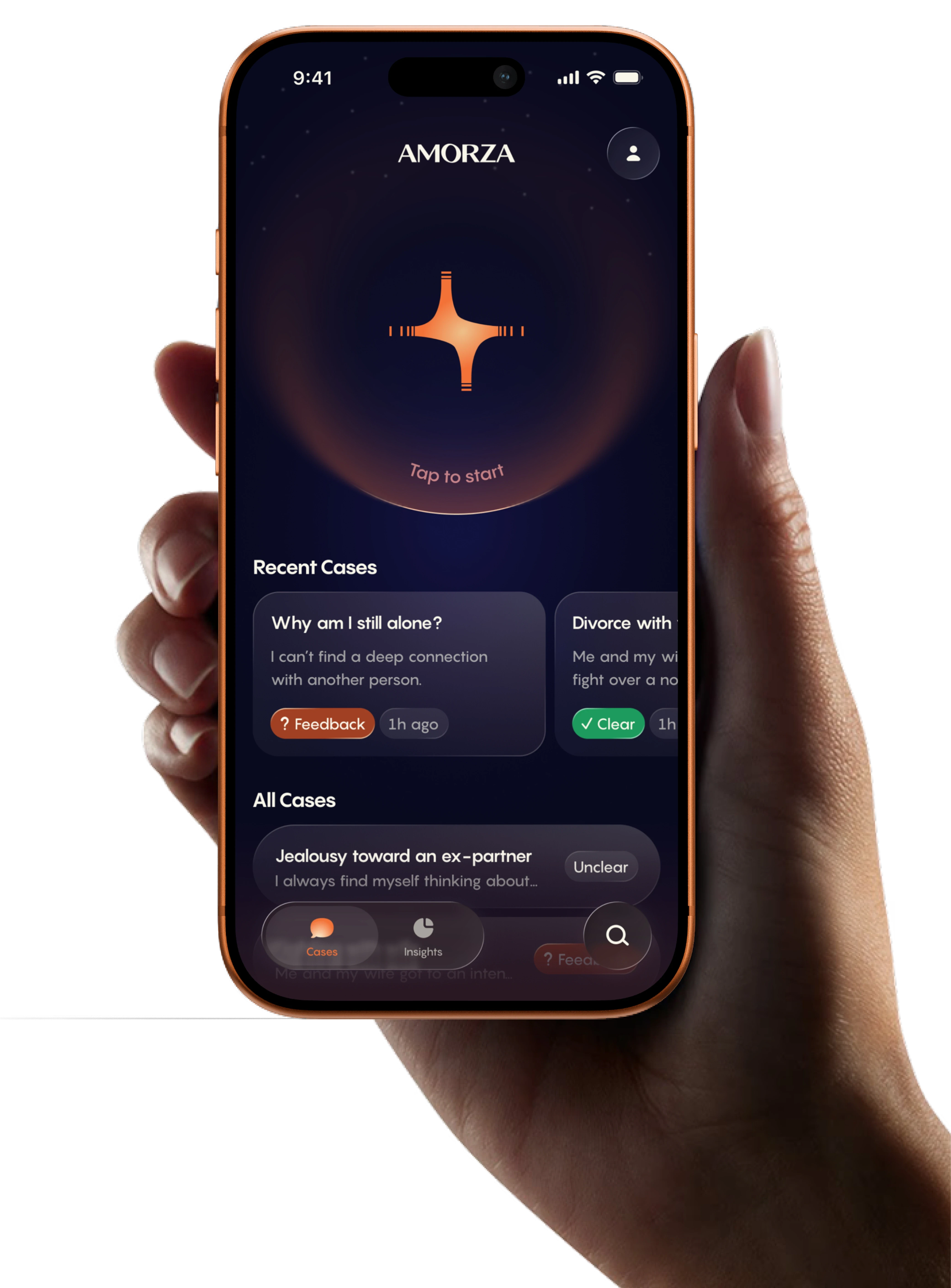
Amorza is an AI tool for relationship clarity.
It is not a substitute for professional psychological or therapeutic support.