UNDERSTANDING YOUR ATTACHMENT PATTERNS
Attachment Patterns
UNDERSTANDING YOUR ATTACHMENT PATTERNS
7 min read
The way you connect with other people can reveal a lot about how you experience relationships. Attachment patterns influence how you respond to closeness, distance, conflict, and emotional connection. Understanding your attachment style can help you recognize patterns in your relationships and better understand what you need from yourself and others.
WHAT ARE ATTACHMENT PATTERNS?
Attachment patterns describe the ways we tend to connect with other people, especially in close relationships.
They can influence how comfortable we feel with intimacy, how we respond when someone becomes distant, and how we communicate when something feels wrong.
You might notice that you become anxious when someone doesn't respond.
You might feel uncomfortable when someone gets too close.
You might constantly look for reassurance.
Or you might feel comfortable being close to someone while still maintaining your independence.
These reactions aren't random.
They can be part of your attachment pattern.
WHY DO ATTACHMENT PATTERNS MATTER?
Relationships can bring out emotional reactions that we don't always understand.
You might know that you're overthinking, but not understand why.
You might know that you pull away during conflict, but struggle to stop doing it.
You might want closeness but become uncomfortable when someone actually gets close to you.
Understanding attachment patterns gives you another way to look at these reactions.
Instead of simply asking:
"What's wrong with me?"
You can start asking:
"What pattern am I experiencing right now?"
That small change can create more awareness and make your reactions easier to understand.
THE FOUR COMMON ATTACHMENT STYLES
Attachment theory is often described using four main attachment styles: secure, anxious, avoidant, and fearful-avoidant.
These aren't permanent personality types.
People can show different patterns in different relationships and situations, and their attachment patterns can change over time.
Still, understanding the general patterns can be useful.
SECURE ATTACHMENT
People with more secure attachment tend to feel relatively comfortable with emotional closeness and independence.
They can communicate their needs without constantly worrying about rejection.
They can usually trust their partner while still maintaining their own identity.
Conflict can still be difficult, but it doesn't necessarily feel like a threat to the entire relationship.
Secure attachment doesn't mean having a perfect relationship.
It means having a greater sense that problems can be communicated and worked through.
ANXIOUS ATTACHMENT
Anxious attachment can involve a strong need for reassurance and a heightened sensitivity to signs of rejection or distance.
You might notice yourself thinking:
"Are they still interested in me?"
"Why haven't they replied?"
"Did I do something wrong?"
"Are they losing feelings?"
When someone becomes distant, even temporarily, your mind may immediately start looking for an explanation.
This can lead to overthinking, checking, seeking reassurance, or becoming especially focused on the relationship.
The desire for closeness isn't the problem.
The difficulty can come when uncertainty becomes overwhelming.
AVOIDANT ATTACHMENT
Avoidant attachment can involve feeling uncomfortable with too much emotional closeness or dependence.
You may value independence strongly.
You may find it difficult to talk about your feelings.
When a relationship becomes more serious, you might feel the need to create distance.
During conflict, you may prefer to withdraw rather than continue the conversation.
This doesn't necessarily mean you don't care about the other person.
Sometimes creating distance can simply be a way of protecting yourself from emotional discomfort.
FEARFUL-AVOIDANT ATTACHMENT
Fearful-avoidant attachment can involve wanting closeness while also being afraid of it.
You may want a deep connection with someone but become uncomfortable when the relationship starts feeling too close.
You might move toward someone and then pull away.
You might want reassurance but struggle to trust it.
This can create a cycle that feels confusing for both people.
You want connection, but connection can also feel risky.
HOW ATTACHMENT PATTERNS SHOW UP IN RELATIONSHIPS
Attachment patterns don't only appear when you're dating.
They can show up in everyday interactions.
For example, imagine your partner doesn't respond to a message for several hours.
One person might think:
"They're probably busy."
Another might think:
"Something is wrong. They're losing interest."
Someone else might think:
"This is exactly why I don't like depending on people."
The situation is the same.
The emotional response is different.
That's one reason understanding your own patterns can be useful.
ATTACHMENT PATTERNS AND CONFLICT
Conflict can make attachment patterns especially visible.
Someone with anxious tendencies may want to talk immediately.
Someone with avoidant tendencies may want space.
One person moves closer.
The other moves away.
The more one person pursues, the more the other withdraws.
The more the other withdraws, the more anxious the first person becomes.
This can create a cycle that neither person intentionally created.
Recognizing the cycle can be more useful than blaming one person for the problem.
Instead of asking:
"Who is wrong?"
Try asking:
"What pattern are we getting stuck in?"
YOUR ATTACHMENT STYLE IS NOT YOUR DESTINY
Attachment styles can help explain patterns, but they shouldn't become labels that define you.
You aren't simply "an anxious person" or "an avoidant person."
People can behave differently depending on the relationship, their experiences, and what is happening in their lives.
Your attachment patterns can also change.
With greater self-awareness, healthy communication, supportive relationships, and intentional work, people can develop more secure ways of connecting.
The goal isn't to fit perfectly into one category.
The goal is to understand yourself better.
HOW TO RECOGNIZE YOUR OWN PATTERNS
Start by looking at what happens when you feel emotionally uncertain.
Ask yourself:
What do I usually do when someone becomes distant?
How comfortable am I asking for reassurance?
Do I tend to pursue or withdraw during conflict?
How do I react when someone gets emotionally close?
Do I worry about being rejected or abandoned?
Do I find it difficult to depend on someone?
What happens to my behavior when I feel insecure?
Don't focus on one specific situation.
Look for repetition.
Patterns become easier to recognize when you look at several relationships and situations over time.
UNDERSTANDING YOUR PART IN THE PATTERN
Understanding attachment isn't about blaming yourself.
It's about becoming more aware of what happens automatically.
Maybe you send several messages when you're anxious.
Maybe you shut down when a conversation becomes emotional.
Maybe you assume rejection before you have enough information.
Once you notice the pattern, you have more opportunity to respond differently.
You can pause.
You can communicate.
You can ask questions.
You can decide whether your reaction is based on what is happening now or something you learned from previous experiences.
Awareness creates choice.
FROM REACTION TO AWARENESS
You can't always control the first emotion that appears.
You can, however, become more aware of what you do next.
If you feel anxious, you don't have to immediately seek reassurance.
If you feel overwhelmed by closeness, you don't necessarily have to disappear.
If you're afraid of rejection, you can communicate instead of assuming.
This doesn't mean ignoring your emotions.
It means giving yourself enough space to understand them before acting on them.
UNDERSTANDING YOUR ATTACHMENT PATTERN
Your attachment pattern is only one part of your relationship story.
It doesn't explain everything about who you are or why a relationship works or doesn't work.
But it can give you a useful perspective.
It can help you recognize why certain situations trigger strong reactions, why you repeat certain behaviors, and what you may need in order to feel more secure.
The more you understand your patterns, the easier it becomes to separate your automatic reactions from the choices you actually want to make.
Understanding your attachment pattern isn't about putting yourself into a box. It's about understanding yourself well enough to create healthier connections.
EXPLORE MORE ABOUT RELATIONSHIPS
Get a deeper understanding of yourself and your relationships with Amorza. Explore your thoughts, emotions, patterns, and connections — and find more clarity in the way you love and communicate.

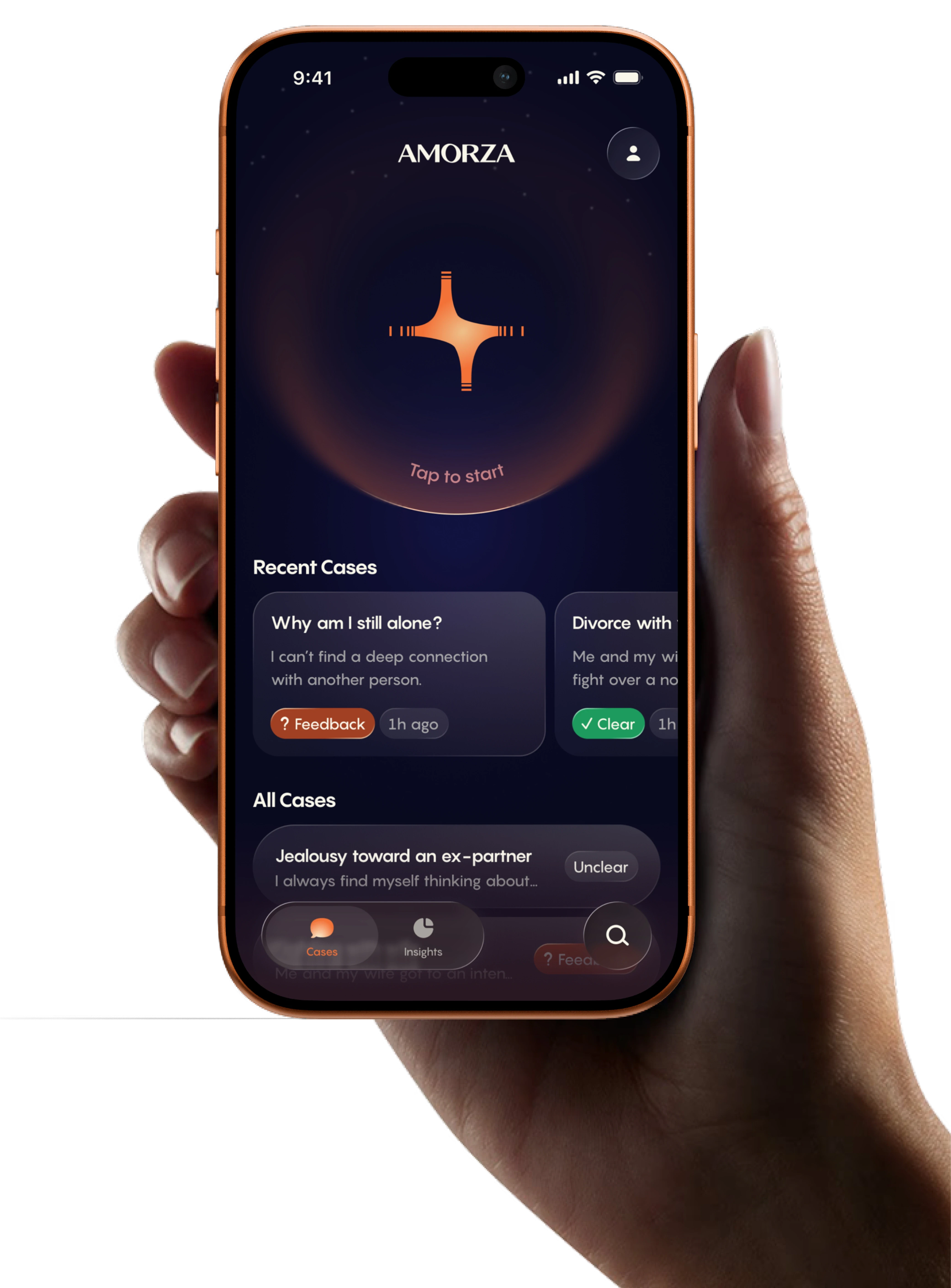
Amorza is an AI tool for relationship clarity.
It is not a substitute for professional psychological or therapeutic support.