HOW TO STOP BEING AFRAID OF LOSING SOMEONE YOU LOVE
Relationships
WHY ARE WE AFRAID OF LOSING SOMEONE WE LOVE?
When someone becomes important to you, the possibility of losing them can feel frightening.
You may start thinking about everything that could go wrong.
What if they stop loving me?
What if they meet someone else?
What if we break up?
What if something changes?
These thoughts can become especially strong when you care deeply about the relationship.
The problem is that your brain can start treating a possible future as if it were already happening.
You are not necessarily reacting to something your partner has done.
You are reacting to the possibility that something might happen.
FEAR DOESN'T ALWAYS MEAN SOMETHING IS WRONG
Feeling afraid of losing your partner doesn't automatically mean your relationship is unhealthy.
Sometimes fear simply comes from caring about someone.
You may have experienced a difficult breakup before. You may have been hurt in a previous relationship. Or you may simply struggle with uncertainty.
The important question is not:
"Why am I afraid?"
It's:
"Is my fear based on what is actually happening in my relationship?"
There is a difference between anxiety and information.
If your partner consistently shows up for you, communicates openly, and makes you feel valued, your fear may be coming from inside rather than from the relationship itself.
But if your partner is repeatedly distant, dishonest, or inconsistent, your feelings may be pointing toward a real relationship problem.
STOP TRYING TO CONTROL THE FUTURE
One of the hardest parts of relationships is accepting that you cannot completely control what happens next.
You cannot guarantee that someone will always love you.
You cannot control how another person feels.
You cannot eliminate every possible risk.
Trying to do so can create even more anxiety.
You might constantly check their phone.
Ask where they are.
Need reassurance.
Analyze their behavior.
Change yourself to keep them interested.
But none of these things can guarantee that a relationship will last.
Security doesn't come from controlling everything.
It comes from knowing that you can handle uncertainty.
DON'T TURN FEAR INTO CONTROL
Fear of losing someone can sometimes change the way you behave.
You might become overly protective.
You might want to know where your partner is all the time.
You might get uncomfortable when they spend time with other people.
You might constantly check their social media.
These behaviors can feel like ways of protecting the relationship.
But they can create the opposite effect.
A healthy relationship needs trust and independence.
Your partner should be able to have friends, interests, routines, and time alone without it automatically becoming a threat to the relationship.
Love isn't about keeping someone close enough that they can't leave.
It's about building a relationship where both people choose to stay.
BUILD A LIFE OUTSIDE YOUR RELATIONSHIP
Sometimes the fear of losing a partner becomes stronger when the relationship becomes your entire world.
Your partner becomes your main source of happiness, social connection, emotional support, and validation.
Then the idea of losing them doesn't just feel like losing a relationship.
It feels like losing everything.
Having your own life can create a much stronger sense of security.
Spend time with friends.
Work toward your own goals.
Keep your hobbies.
Take care of yourself.
Do things that make you feel like yourself outside the relationship.
A healthy relationship should add to your life, not replace it.
ASK YOURSELF WHAT YOU ARE ACTUALLY AFRAID OF
Sometimes "I'm afraid of losing my partner" isn't the complete story.
You might actually be afraid of being alone.
Or being rejected.
Or feeling like you're not good enough.
Or having to start over.
Or experiencing the same pain you experienced in the past.
Try finishing this sentence:
"If this relationship ended, I would be most afraid of..."
Your answer can tell you a lot.
Once you understand the real fear underneath the fear of losing someone, it becomes easier to work with it.
LEARN TO TRUST YOURSELF
Trust in a relationship isn't only about trusting your partner.
It's also about trusting yourself.
Trusting that you can recognize when something isn't right.
Trusting that you can communicate your needs.
Trusting that you can set boundaries.
And trusting that even if a relationship eventually ends, you will be able to move forward.
This is an important shift.
Instead of thinking:
"I need to make sure they never leave."
You start thinking:
"I want this relationship, but I know I will be okay even if life changes."
That doesn't make you care less.
It makes your love less dependent on fear.
TALK TO YOUR PARTNER ABOUT YOUR FEARS
You don't have to hide your insecurity from your partner.
But there is a difference between sharing your feelings and making your partner responsible for constantly removing them.
Instead of:
"You need to prove that you're not going to leave me."
Try:
"Sometimes I get scared of losing you, even when I know there isn't necessarily a reason to feel that way."
This creates vulnerability instead of pressure.
A supportive partner may be able to reassure you, but reassurance works best when it becomes part of a larger conversation rather than something you need repeatedly throughout the day.
WHEN THE FEAR BECOMES CONSTANT
If you're constantly worried about losing your partner, it can affect the relationship itself.
You may stop enjoying the moments you have together because you're already thinking about when they might end.
You may analyze everything they say.
You may become dependent on reassurance.
You may interpret normal independence as rejection.
And eventually, the fear can create the exact distance you were trying to prevent.
If you notice that your thoughts about losing your partner are taking over your daily life, it may be worth stepping back and looking at the pattern more carefully.
The goal isn't to convince yourself that you'll never lose anyone.
The goal is to feel secure enough to enjoy the relationship while it exists.
LOVE WITHOUT CONSTANT FEAR
Loving someone always involves some vulnerability.
You can't completely remove the possibility of getting hurt.
But you don't have to spend the entire relationship preparing for the worst.
Pay attention to what is actually happening.
Communicate when something feels wrong.
Trust your partner when their actions give you reasons to trust them.
Keep your own identity.
And remember that uncertainty doesn't automatically mean danger.
Sometimes the healthiest thing you can tell yourself is:
"I don't know what the future holds. But I know what is happening right now."
You don't need to guarantee that someone will stay forever to have a meaningful relationship today.
Love becomes easier when you stop trying to control the future and start understanding the relationship you actually have.

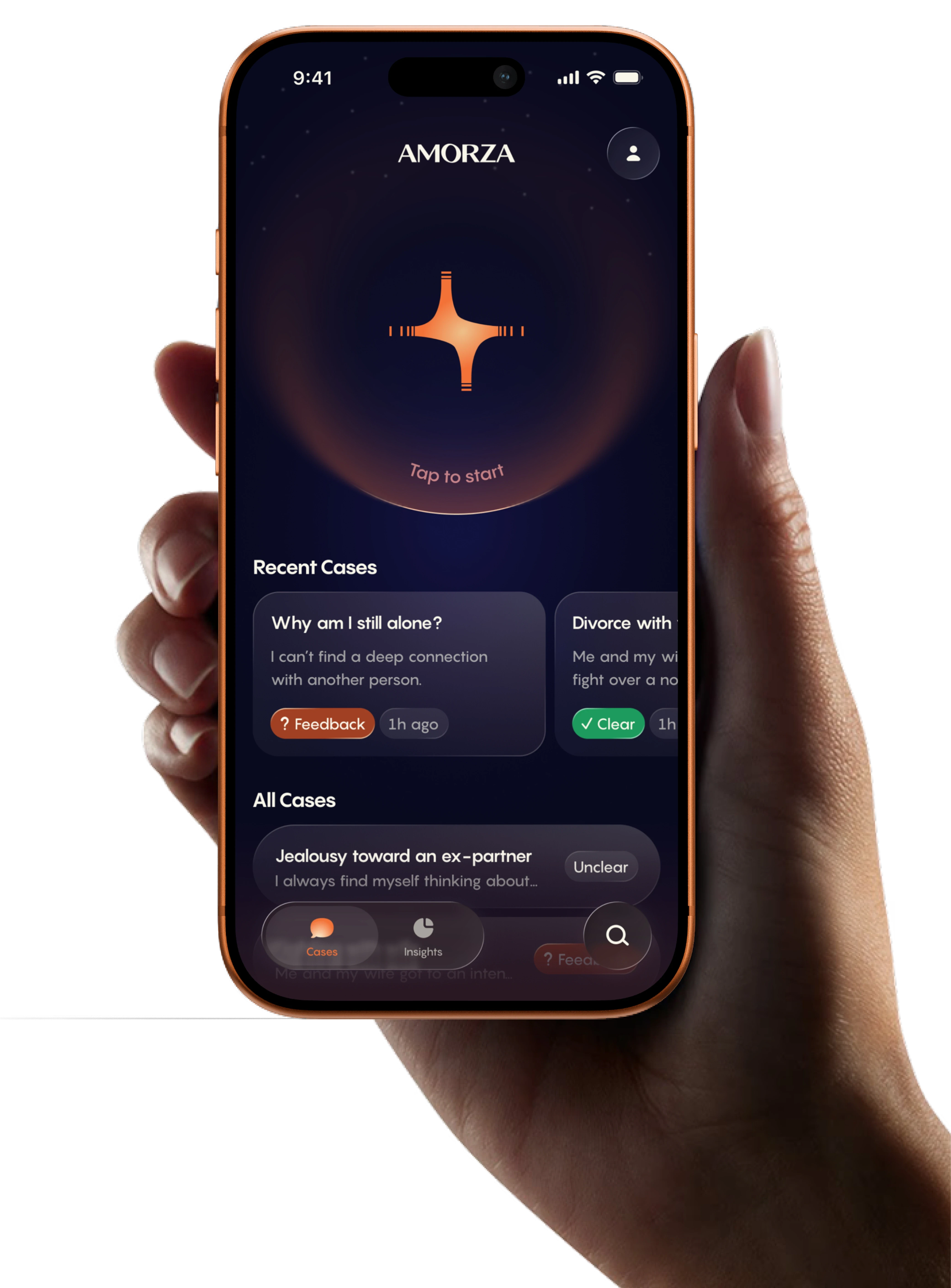
Amorza is an AI tool for relationship clarity.
It is not a substitute for professional psychological or therapeutic support.