HOW TO STOP OVERTHINKING IN A RELATIONSHIP
Relationships
Why Do We Overthink in Relationships?
Overthinking in a relationship usually starts with uncertainty.
You notice something small. Your partner takes longer to reply. Their message feels shorter than usual. They seem distracted when you're together. Maybe they don't say goodnight like they normally do.
At first, it's just a thought.
Then another one appears.
Are they upset with me?
Did I do something?
Are they losing interest?
And suddenly, you're trying to understand an entire relationship from one text message.
This is what makes relationship overthinking so exhausting. Your brain is trying to create certainty from incomplete information.
The problem isn't that you care too much. It's that your mind starts treating possibilities as facts.
The Difference Between Thinking and Overthinking
Thinking about your relationship can be healthy. You should be able to notice patterns, reflect on your behavior, and ask whether your needs are being met.
Overthinking is different.
It usually looks like:
Replaying the same conversation over and over
Analyzing every text message
Looking for hidden meanings in small changes
Constantly asking yourself whether your partner still cares
Imagining negative scenarios without evidence
Checking when they were last online
Needing repeated reassurance
Trying to predict what your partner will do next
The more you analyze, the more uncertain you can become.
That's because overthinking rarely gives you new information. It gives you more interpretations of the same information.
Why Do We Overthink Someone We Love?
There are several reasons people overthink relationships.
1. You don't feel secure
When a relationship feels uncertain, your brain naturally looks for answers.
Maybe the relationship is new. Maybe something changed recently. Maybe you've had difficult experiences in previous relationships.
Uncertainty creates space for your mind to fill in the blanks.
2. You're afraid of losing the relationship
The more important someone becomes, the more there is to lose.
That can make ordinary situations feel much more significant.
A delayed reply isn't necessarily a problem. But when you're afraid of losing someone, your brain can interpret it as a warning.
3. You're relying on reassurance
Reassurance can feel incredibly calming in the moment.
You ask, "Are we okay?"
They say yes.
You feel better.
But if you constantly need reassurance to feel safe, the relief usually doesn't last. Soon, you need another answer.
This can create a cycle where uncertainty leads to anxiety, anxiety leads to reassurance, and reassurance only temporarily reduces the anxiety.
4. Something actually feels different
Not every concern is overthinking.
Sometimes your intuition is reacting to a genuine change in the relationship.
Your partner may actually be more distant. Communication may have changed. A recurring problem may not be getting resolved.
The goal isn't to convince yourself that everything is fine.
The goal is to understand what is actually happening before deciding what it means.
Stop Trying to Read Your Partner's Mind
One of the biggest causes of relationship overthinking is trying to answer questions you don't actually have enough information to answer.
Why didn't they reply?
What does that message mean?
Why did they like my message instead of responding?
Are they talking to someone else?
There may be ten possible explanations.
And you usually don't know which one is true.
Instead of asking:
"What does this mean?"
Try asking:
"What do I actually know?"
For example:
What you know:
They haven't replied for six hours.
What you don't know:
Why they haven't replied.
What your mind is adding:
They're losing interest.
That distinction matters.
Facts are information. Interpretations are possibilities.
Keeping them separate can immediately reduce the amount of anxiety around a situation.
Look for Patterns, Not Isolated Moments
One strange text message doesn't tell you much about a relationship.
Patterns do.
If your partner is normally affectionate but sends a short message one afternoon, there's probably not much to analyze.
If they've been emotionally distant for several weeks, stopped initiating conversations, and repeatedly avoid spending time together, that's different.
Relationship clarity comes from looking at the bigger picture.
Ask yourself:
Is this a one-time event or a repeated pattern?
Has their behavior actually changed?
How do they usually behave toward me?
Have I already talked to them about this?
Is there evidence for the conclusion I'm making?
Am I reacting to what is happening now or something that happened in the past?
This moves you from guessing toward understanding.
Don't Make Decisions While You're Anxious
When you're overthinking, you often want to do something immediately.
Send another message.
Ask for reassurance.
Start an argument.
Check their social media.
End the relationship.
Do anything that makes the uncertainty disappear.
But urgency doesn't always mean something needs to be done immediately.
Sometimes the best decision is to wait until you feel calmer and have more information.
Before sending that message, ask yourself:
"Am I communicating because I have something important to say, or because I want to stop feeling anxious?"
Those are very different reasons.
Talk About What You Actually Need
If something in the relationship is bothering you repeatedly, don't make your partner guess what is happening inside your head.
Talk about it.
Instead of:
"You don't care about me anymore."
Try:
"I've noticed we've been spending less time together recently, and I've been feeling disconnected from you. Can we talk about what's changed?"
The first statement creates a conclusion.
The second creates a conversation.
Healthy communication doesn't require you to hide your insecurity. It requires you to communicate the insecurity without turning it into an accusation.
What to Do When You Can't Stop Overthinking
When you notice yourself spiraling, try this simple process.
Step 1: Stop
Don't send the message yet. Don't check their social media. Don't make a decision.
Give yourself a moment.
Step 2: Separate facts from assumptions
Write down what you actually know.
Then write down what you're assuming.
Seeing the difference on paper can make the situation feel much smaller.
Step 3: Look at the pattern
Ask whether this is an isolated moment or something that keeps happening.
Step 4: Identify what you need
Do you need information?
Reassurance?
A conversation?
A boundary?
Or are you simply uncomfortable with not knowing?
Step 5: Decide what deserves action
Not every uncomfortable thought requires a response.
Some situations need a conversation.
Some need time.
And some need you to let the thought pass without acting on it.
When Overthinking Is Telling You Something
The goal isn't to stop thinking about your relationship completely.
Sometimes overthinking is a signal that something needs your attention.
If you repeatedly feel confused, anxious, or uncertain around the same person, don't automatically blame yourself for being "too sensitive."
Ask what the uncertainty is connected to.
Is your partner inconsistent?
Do they avoid difficult conversations?
Do you feel like you have to constantly guess where you stand?
Are your needs being communicated but ignored?
Are you constantly looking for reassurance because the relationship doesn't actually feel secure?
These questions are more useful than endlessly analyzing one text message.
You Don't Need to Figure Everything Out Alone
Relationships can be difficult to understand because you're inside the situation.
You know what happened, how you felt, what they said, what happened before — but that can also make it harder to see the larger pattern.
Sometimes what you need isn't another opinion telling you what to do.
You need clarity.
You need to understand what is happening, what might be driving it, and what your options actually are.
That's where stepping back from the immediate emotion can help.
The goal isn't to stop caring.
It's to stop letting uncertainty make every decision for you.
More clarity. Less guessing. More understanding. Less overthinking.
Key takeaways
Overthinking often comes from trying to create certainty from incomplete information.
Facts and interpretations are not the same thing.
Look for relationship patterns instead of analyzing isolated moments.
Don't make important decisions while you're emotionally overwhelmed.
Communicate what you actually need instead of expecting your partner to guess.
Not every anxious thought requires action.
Sometimes overthinking is a signal that a real relationship problem needs attention.

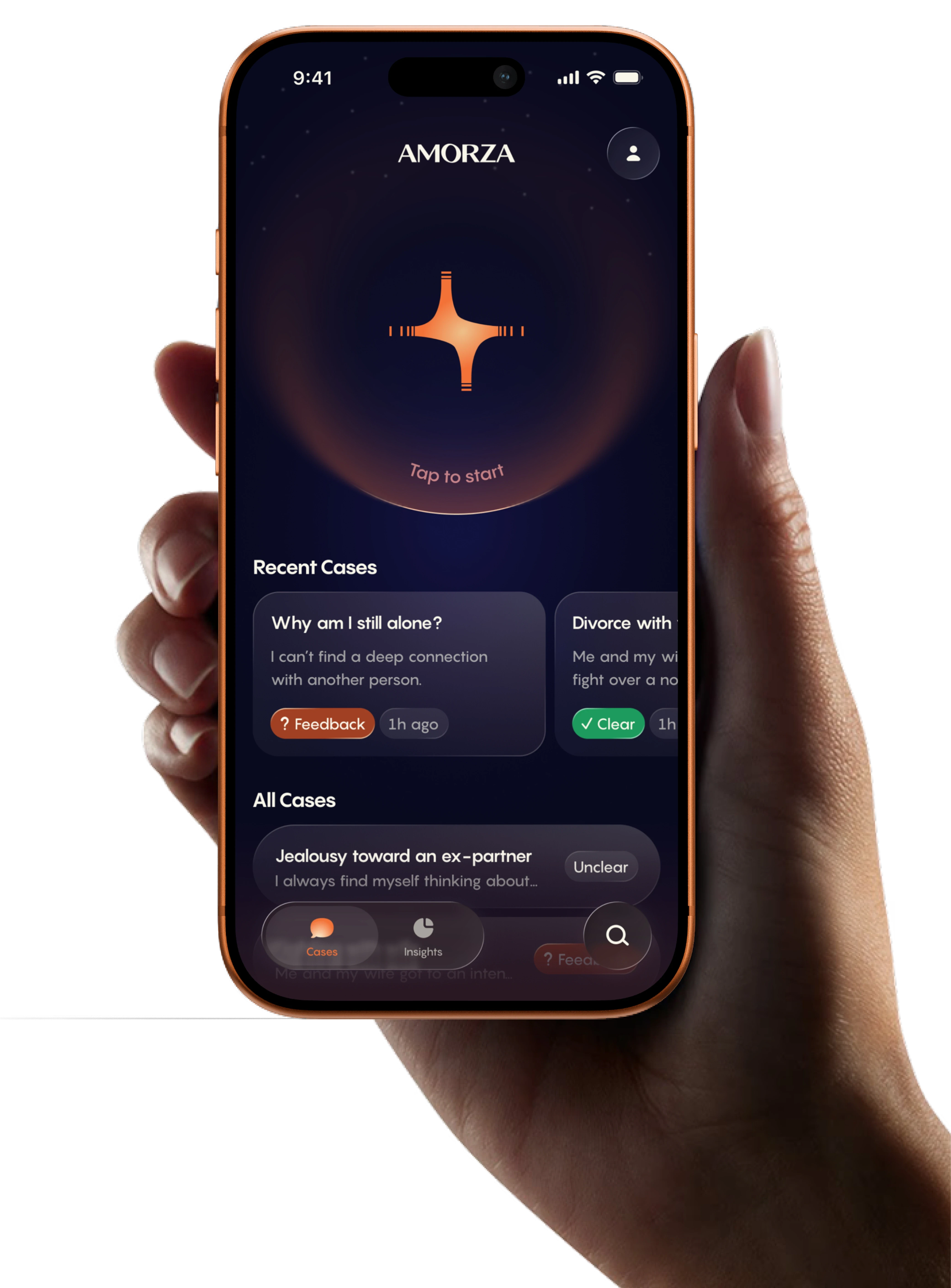
Amorza is an AI tool for relationship clarity.
It is not a substitute for professional psychological or therapeutic support.